Can Value Engineering Really Achieve Major Savings?

Value Engineering has become the core activity for may cost engineers / quantity surveyors / commercial managers on major construction projects around the world, while at the same time being viewed as a silver bullet by clients when projects are over budget.  However, can value engineering really be used as a tool to rectify “financially distressed” projects?

First, it is important to remember the purpose and definition of value engineering (as promoted by SAVE™ and similar organisations), which is to identify better ways of achieving the same result.  The focus is therefore on maximizing or improving value rather than simply reducing cost.  Many people have lost sight of this fundamental concept of value engineering:

VALUE  ≠  COST

So, how are these two terms really defined?

The “cost” of a development or component is the capital expenditure incurred in securing the physical achievement of that asset.  It is also all the direct expenditure incurred in operating and owning that asset throughout its lifetime (such as utility costs, repairs, and maintenance).

The “value” of the same item includes not only all the direct “costs” incurred, but also the income and benefit that item can generate for the owner over its whole life.

Therefore, whilst costs can include all expenditure over the whole life period, there is no consideration of the benefits (“income”) generated.  This makes decisions potentially clouded by a focus on the outflows of money rather than taking a more complete look at the consequences of ownership.  Despite everyone agreeing that decisions should be taken in an informed and rational manner, it has become inevitable that capital expenditure decisions now dominate the construction industry.

Consequently, visual elements within a construction project are typically the first to be targeted, for example, architectural finishes and landscaping.  This approach actually results in a more significant value reduction than the simple cost savings indicate.

In the case of residential properties, many prospective buyers are strongly influenced by the visual appearance of the completed building and its surroundings (including amenities).  If corners are cut, there is an immediate perception of lower “quality”.  Where multi-unit developments are concerned attracting buyers is important, since as interest / demand increases so do the ultimate sale price.  Buyers are also keen to secure properties, which require limited or no additional investment (for further fitting out / landscaping works), therefore “move ready” assets are very attractive to many investors.

There is a current trend within the commercial property market globally for small to medium sized firms to be particularly attracted to partially fitted out floor space (raised floors and suspended ceilings pre-installed), rather than the more traditional shell and core tenancy spaces.  Global leasing data (irrespective of market location) validates the conclusion that providing space in this partially fitted out format attracts a premium rental rate, and also attracts tenants who are prepared to commit to longer occupancy periods.  When the additional capital investment involved is compared with the enhanced returns, (“value”) generated the overall resultant financial benefit repays the extra cost in a very quickly.

When can Value Engineering Really Make a Difference?

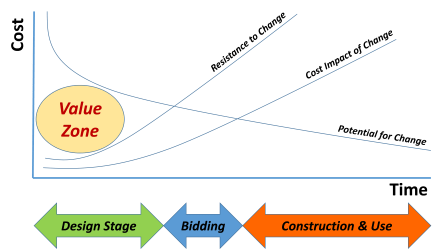
Whilst value engineering can be carried out at any point in the project life cycle, the earlier in the design process it is performed the better the results tend to be.  As the project evolves, the design team become reluctant to embrace changes, which might involve them in additional non-recoverable expense.  Equally, the cost impact of the changes proposed at these later stages will involve other factors beyond the simple capital cost (often; abortive work and consequential impacts).

This means that there is a zone at the beginning of a project where value engineering can make the largest impact with the least consequences, this is known as the “value zone” and is illustrated below.

value-zone

Setting Expectations

A common question from many clients before undertaking any value engineering exercise is “how much should be the target for the savings we can achieve?”  There is obviously no specific answer to this question since it depends upon the project and status of the design, but the expectations established at the start have to be realistic.

The financial issues on a project cannot be solved by a single value engineering exercise, nor can significant savings be achieved without major design changes.  Therefore, it is important to consider what can actually be achieved.  To establish a reasonable target a detailed review of the project design and latest cost estimate has to be carried out.  This review should consider the following key issues:

  • Scope / potential for brief / functional area reductions
  • Practicality to implement alternative building services systems / technology
  • Ability to consider alternative structural systems
  • Areas of uncertainty in the estimate pricing
  • Aspects of the design which are less developed

Designers, suppliers, and contractors can all assist in this review by providing the evaluation team with expert knowledge and technical information.  Building Service systems are a key aspect where manufacturers and suppliers can provide significant support.  The best of these businesses are able to offer alternative solutions to standard problems, (many of which involve higher capital investment but substantial long-term benefits) based upon the selection of different items from their existing product range.  This ability to think and work outside the “easy” or “regular” solution is what distinguishes the good from the best suppliers.  Successful value engineering studies always require the active involvement of these firms and design teams should actively seek out these experts wherever possible.

Despite the vast number of variables in the design of any project, it is typical that savings of between 15 – 20% of capital costs, are possible during the early stages of the design process, with between 10 – 12% being the most commonly achieved cost reduction range.  As noted at the outset, these savings have to be tempered with the potential loss of revenue / other benefits any cost reductions might consequentially generate.  As a rule, the higher the achieved capital cost savings, the greater the overall compromise in other areas, which will result.

Final Thought

Value Engineering is not a silver bullet; it is simply an additional tool within the toolbox of the construction industry professional.  If used at the appropriate time the process can generate savings and reduce budget over-runs, but it will often be at the expense of either functionality or aesthetics.

If you want to read more about a structured process (called the “funnel” approach) designed specifically to reduce project costs without destroying value, please look at our Practical Guide to Performing Effective Value Engineering.

6 Things to Consider When Performing an Assessment of a Contractor’s Variation Claim

Introduction

Variations are the inevitable aspect of all forms of construction and irrespective of the project type change will always occur.  How change is managed and controlled determines the outcome of the project, consequently the majority of construction disputes around the world centre on variations.  The evaluation and agreement of variations is a core activity all construction professionals have to understand.  This article highlights 6 important issues to consider when reviewing any variation submission from a contractor all of which are applicable to every type of construction project irrespective of location or contract form.

Written Instruction

The vast majority of construction contracts (irrespective of procurement route) envisage variations or changes to the original scope of work and include specific clauses setting out how they are to be evaluated.  What all these provisions have in common is that they require the instruction to change the scope of work, to be in a written format.  Whilst there is extensive legal precedent establishing that variations can arise from verbal directions, intentions, actions, and implied statements, the fundamental requirement of a contact is for the change to be communicated clearly.  Therefore using a written format is the expected medium.

It is this particular aspect, which is one of the major root causes of numerous construction disputes, because the clarity expected from an instruction is lacking.  Many clients and consultants feel that by being vague or resisting the issue of formal instructions somehow protects them from increased costs, delays, or claims on a project.  This quite simply is not the case.  A clear instruction sets out exactly what the contractor has to do, and how it revises the original scope of work.  It should also be remembered that an instruction does not have to have any financial or time consequences, but it removes doubt and provides clarity on what the parties expect.  Furthermore, it ensures that there is no doubt about the expectations for the finally completed project.

Therefore, all variations must start with a clear written instruction setting out exactly what is to be modified.  If this is done then the future evaluation can be carried out successfully.  Importantly, if this written instruction does not exist, it is likely no “contractual” variation has been issued and the change should not be evaluated.  Hence, the first and most important check is to validate that there really is a contractual change.

Contract Rates

When considering how to evaluate any construction change it is important to refer to the pricing contained in the contract documentation.  The rates and prices contained in this document form the basis of the contract sum and the contract usually stipulates that these rates must be applied in the evaluation of variations.  In other words, if the variation comprises the addition of 100m3 of concrete, and the contract already has a rate for concrete, the same contract rate must be used for the new work (except in a few extreme situations).

Whilst contractors will attempt to find reasons or ways to avoid using the contract rates, these must be the primary pricing source, unless there are justifiable reasons why the rate is no longer applicable (contractually there are only a limited number of circumstances, which would qualify for abandoning the contract pricing).  The contract rates are the basis of the original deal struck between the parties and a variation should not be used as the basis for rewriting this deal.  It is worth noting that this rule applies even when the pricing may appear to favour the contractor (i.e. the contract rate is higher than normal).

Dayworks / Time & Materials

The assessment of variations using time and materials is also defined under some forms of contract as being a daywork evaluation.  Although many contractors consider this approach to be the fairest method of determining the value of a construction variation (because it is supposed to compensate them for the actual costs incurred), most contracts consider this as being the last of the evaluation methods to be adopted.  The use of contract rates and prices must therefore be the primary evaluation approach.  Only if the variation involves a completely different type of work, should this time and materials method be considered, and even then with strict rules.

Some contract forms require that a specific direction should be issued permitting the use of “Dayworks” as the evaluation method.  Where this instruction is required, there is also an obligation on the contractor and supervision team to record / validate the resources deployed for the instructed work.  Without these records and validation, the daywork evaluation should not be accepted.

Although this maybe a clear contractual requirement, the practical reality is that, the records are rarely prepared correctly at the time with the necessary verification, taking place.  Furthermore, the formal direction / approval to use dayworks as the evaluation process is rarely stated in the instruction issued.  The result is that the consultants carrying out the final evaluation of the variation usually have to accept the information provided on face value.  Despite these common failings, it is always worth the effort in trying to establish the validity of the items claimed by referring to actual site diary records made at the time.

Quotations

The submission of quotations as substantiation for a variation assessment is a common approach adopted by many contractors.  Whilst these documents are essential supporting information when determining the value of any variation, they have to be carefully checked before being accepted.  The following are some of the important checks to be undertaken:

  • Ensure the issuing company is approved to perform the proposed work
  • Verify if the quotation includes the full scope of work
  • Check the exclusions to ensure they are covered elsewhere if necessary
  • Check the payment terms – these may not be acceptable and result in an increased price
  • Check the time for completion of the works to ensure programme compliance
  • Validate if the quotation reflects any trade or commercial discounts

It is also important to recognise that the quotation received for the variation work will typically not be competitively obtained, especially if the supplier or sub-contractor is already performing work on the project.  In these cases, it is always beneficial to try to seek alternative quotations to validate the pricing proposed.


Ultimately, just because there is a quotation, it does not mean it has to be accepted blindly.  The above checks are what should be regarded as being the minimum due diligence undertaken before any quotation is considered for inclusion in the variation assessment.

Savings & Omissions

One of the most overlooked aspects of any variation assessment is the potential for savings or omissions from the original scope of work.  In most cases, construction variations revise work, which was already part of the original scope.  This means that something already existed in the contract, but is now being changed.  Even when purely additional work is being instructed, there may still have been something originally in the physical location of the new work.

In all cases it is important that the contract information be reviewed to establish clearly what was originally proposed before the change was introduced.  An example might be a new sub-station has been introduced, whilst this is a completely new building, the ground it sits upon might have been part of the external landscaping, and in which case, there would be an omission of the original landscaping work.

It is therefore rare for any construction variation to be purely an extra without the omission of some previous work.

Abortive Works

Following on from the above, the most common situation where the original work cannot be omitted would be when the work had already been constructed.  In these situations, there would be abortive work (i.e. completed work has to be removed / demolished / altered).  Abortive work falls broadly into two categories; work, which has been constructed, and works that, is no longer required.

Where constructed work has to be removed, it is important to establish first, exactly what was there before the instruction was issued.  Site records made at the time (referred to as contemporaneous records) are the key to making this determination and reliance on the views / opinions of the contractor should be resisted.

In the case of materials no longer required for the work, as a direct result of the variation, it is important to answer a number of key questions:

  • Can the surplus materials be used elsewhere on the project?
  • Are the materials actually purchased and on site?
  • Are these materials still in good condition?
  • Can the materials be returned to the supplier for a refund?

Only if these issues are clarified should the abortive materials be incorporated into the variation assessment.

Conclusion

The valuation of variations on a construction project must be carried out with care and based upon verified information.  There are many aspects to consider when determining the value of a variation, but if the whole process is carried out methodically, with each stage being checked and verified systematically, the result will comply with the contractual requirements.  Furthermore, any assessment, which is based upon appropriate checks, will be harder to dispute in the future.  Although this will not avoid future disputes, it will reduce the areas of difference to only those aspects where there is a genuine disagreement because the justification and basis are clearly presented.

To understand more about the assessment of post contract variations, including how they should be monitored and reported during the construction stage, please see the Practical Guide to Contract Administration – Variations, Cost Reporting & Final Accounts.

The Do’s and Don’ts of Using Construction Cost Price Books

It is the season for releasing updated editions of major construction cost price books around the world and as these new books arrive in the mail or updated databases are made available on-line it is important to remember how these documents should be used and interpreted.  In the fast-paced construction world, industry practitioners often rely on published cost data to prepare feasibility or initial construction cost estimates.  In doing so, little thought is usually given to the consequences of these actions or the validity of the professional advice being provided.

Just because the construction cost price book has been prepared and published, by a reputable source does not mean the contents are reliable or a substitute for professional estimating services.  This article will consider how these pricing books are really compiled and consequently their benefits and drawbacks.

Sources of Cost Data

So, where does the cost data for a construction cost price book originate?  Despite the claims by most publishers, construction cost data can come from only a limited number of sources and each generates slightly different information.  Therefore, both the users and compilers need to understand exactly what the basis of the data is.

Tender Price Information – In many ways, this is the best cost information, since it represents the market price secured in a competitive bidding environment.  However, modern construction projects have a wide variety of unique features, which means very few tenders are identical (putting aside the different physical nature of the construction work itself) resulting in a whole host of factors which could directly influence the pricing structure.  Illustrations of this point would be:

  • Contractual Terms and Conditions
  • Procurement Route
  • Level of Competition
  • Local Market Conditions
  • Project Desirability
  • Nature of Project Participants
  • Construction Duration
  • Perceived Project Risks

Each one of the above factors will have an impact on how bidders consider and present their pricing.  Therefore, whilst tender prices are perhaps the best source of construction cost information, it is essential for the details of the identified projects to be understood by whoever is going to use the data.  Simply accepting and using information provided can create significant validity risks.

Another factor affecting the use of tender price information is the quantum of suitable data available.  Most construction cost price books provide generic rates, either for project types (roads, schools, offices, etc.) or for individual components (reinforced concrete, reinforcement, blockwork, copper pipe, etc.), this means the authors need to ensure they have a large enough sample size to produce a representative data set.

Here again there are two significant issues; firstly the number of available tenders of a similar type (comparing all school tenders, irrespective of the project type is not going to be appropriate), may not exist, and secondly when the tenders were actually issued / received (often there is a significant time gap between tenders being received and the data being made available to third parties).  The consequence of these situations is often that the valid sample size available for the price book compiler is very small (sometimes only 1 or 2 tenders in any specific category).

A further consideration is that most independent cost data compilers rely on tender information provided by third parties, where the validity of the data is hard if not impossible to interrogate, therefore has to be accepted on face value.  Where the cost data compiler is an industry firm, the reliability of the data should be better, but in these cases, volume of suitable data will become an even greater issue.

Finally, irrespective of the data compiler, many project owners remain reluctant to release the commercially sensitive contract / tender price information from their projects, which further reduces the available data pool.

Quotations / Supply Prices – Some price books heavily focus on providing cost data relating to a wide range of material, labour or plant / equipment items.  These rates are sourced, either from tender prices (as above) or through the solicitation of market quotations / price lists.  Although the information collected is traceable and largely consistent (since the format, structure, and conditions relating to the quotation received can be determined by the originator) these rates do not truly reflect the local market conditions.

In most countries around the world, or within large cities for that matter, supply prices will vary depending upon the exact location of the project.  In the USA for example, there are often significant State-by-State variances, linked to taxation, transportation, supply availability, or climatic conditions.  In Africa, prices in major urban centres will be dramatically different to those found in settings that are more rural.  Some of these issues are addressed through regional factor adjustments (discussed below) but fundamentally, the user of the price book needs to know what is the base point used by the cost data compiler.  The difficulty still remains that there needs be a large enough sample size to make the cost data credible, which means they often use a wide catchment area.

When quotations / supply prices are used as the basis of a cost price book, it is important that the author use the same sources for each edition of the book; this ensures consistency in the pricing.  If different sources are used each time, the cost data is going to be highly unreliable, unless the sample size is statistically significant (so that anomalies can be removed from the data set before averaging takes place).

Regulated / Controlled Prices – In certain markets around the world, the Government or State may impose a capped or regulated price for particular key commodities or services.  This price regulation may come from a government monopoly position in that aspect or it may relate to a key item, which could be subject to market price manipulation if not controlled.  In each case, clearly stating these controls in the price book is critical.  The primary reason is that when the controlled prices are separately adjusted by regional / locational factors (to suit the actual location of the project being priced), the price controls in one location may not apply in the new location, meaning further adjustment to the pricing will be necessary.

Labour Rates – Published labour rates often come in two formats, the pure labour costs (i.e. the amount an individual worker costs) or labour content within a particular rate.  The second aspect (labour content within a particular rate) can be a complete topic by itself, but in simple terms, they are usually a theoretical value based upon the perfect worker performing the specific task in the most efficient manner (therefore exceedingly rare in practice).

Pure labour costs may seem to be a simply obtainable value, especially where there are union controlled, or government dictated minimum wages.  However, this is not the case.  Firstly, it is important to understand the basis of the rates being quoted is the amount the worker receives, “take home”, or are they the cost to the company employing the worker.  The two are significantly different values.  Secondly, the definition of the worker category has to be understood.  It is frequently the case that a particular role requires workers of specific skill level, qualification, years’ experience, or trade certification, ensuring that all the rates compared are for exactly the same type of worker is vital.  Finally, the working conditions of the different labour rates has to be considered, they should all be based upon the same working hours (without overtime), similar shift patterns (day productivity is usually better than night working), and operating conditions (whether below ground or at high level).

In each of the above situations, the number of factors potentially influencing the rate outcome is significant and if the cost price book does not clearly set out the assumptions and methodology adopted, the users of the data can be extremely exposed.

Compilation Process

Once the actual data has been sourced and gathered perhaps the hardest part begins.  Whilst it may seem obvious to average the complete dataset to produce single value, or perhaps apply more complex statistical analysis processes, the result would not be acceptable.  In a perfect world a range of values would be provided in the pricing book (to show the potential spread of outcomes possible), but typically a single value is all that is provided.

The optimum approach to producing a single value is to review the data available for each item in turn.  Where there are outlying rates (i.e. particular rates, which stand out from the remaining data as being too high or low), these rates should be either excluded from the calculation or queried with the original data provider to revalidate the information recorded.  The rest of the data should then be averaged to produce the single mean value.  The fact that this process has to be repeated for every item in the pricing book often means it is not carried out, or there simply is not adequate data available in the first place for every item to determine if the rates provided are consistent.

Timing of Release

Once all the data has been sourced, compiled, analysed, and averaged, it is time for publication.  The construction price book hitting the market now is unfortunately unlikely to be representative of the market today (or in the future for that matter); it reflects the market at the time when the data was sourced.  Irrespective of the publisher, most price books contain cost data, which is at least 6 months old.  Therefore, a 2016 price book published in September probably contains tender price information for projects released to the market in late 2015 or early 2016.  In most developed construction markets, this is acceptable since prices do not fluctuate significantly during the course of any given year.  However, if there have been major geo-political or economic events, which have influenced exchange rates, material supplies, or government regulations, it is possible the cost data is outdated even before it is published.

Some online systems claim to have “real time” updates on price movements.  Whilst this may be technically true to the extent that as new information becomes available the database is updated, it is the timing of the cost data, which is important.  Most tender price information will only (or should only) be released once the evaluation process has been completed and a successful award taken place (which usually takes a minimum of at least 1 month from tender submission).  Therefore, before any analysis by the cost data compiler can take place at least a month will have elapsed from a tender submission.  Then the review and validation process will take a further period before publication can be approved (if the review does not take place the validity of previous data will be called into question).  This lag, between submission and publication will depend upon the processes adopted by the price book compiler but in all cases, it will result in cost data, which is based upon historic information.  It is therefore the obligation of the data publisher to identify clearly the periods used for the source data.

Regional Factors

As a user of a construction cost price book, it is often inevitable that the project being considered for pricing is not exactly in the location where the price book is based.  This means that some sort of adjustment to the information available has to be made to make it appropriate for use.  Many publishers assist in this process by usefully providing regional or locational factors, which can be applied to all the prices depending upon the final project location.  These factors are typically a percentage (either positive or negative) adjustment to be applied to the published rates.

Although this may seem a quick and simple solution to the problem at hand, the factors provided have to be treated with the same level of caution as all the other information.  The general principle behind the location factor is to provide a general guide as to how prices vary from one location to another.  Often they are historical averages or simply reflect different legislation patterns.  However, the basis must be understood and spelt out in the price book.

As a rule, not every rate or price across all items will fluctuate in the same magnitude from location to location.  Whilst as an overall average, the adjustment may be appropriate; if a particular project has, a greater proportion of a particular component than would be the norm, then examining the locational pricing trends of that aspect becomes more important than relying upon just the blended average.

Therefore, it is important to consider not only the physical location of the project, but also the nature of the work being proposed.  In geographically large countries, such as China or USA, regional factors become even more suspect as prices will vary significantly from one side of the country to the other.  In these situations using published information from the actual market, being considered is more important than relying on generic national data with adjustment factors.

Conclusions

Despite the above concerns, there is a role for construction cost price books, but they have to be handled with great care.  Price books provide a valuable source of generic cost information, which allow professionals to gain a rapid understanding of price trends as well as reference point for validating their own estimating.

Provided the users clearly read the basis and methodology provided by the publishers, (assuming this is actually available) then the composition of the cost data can be established.  In the case of projects, which are less sensitive to individual market price fluctuations, such as major infrastructure, or civil engineering projects price books are much more reliable.  For these projects, the use of a price book can be of significant value to the estimator since it will provide base cost data.  This information can then be adjusted to reflect any project specific factors or conditions.

In terms of headline benefits, construction cost price books offer a wealth of market data for those people not actively involved in the construction industry or do not have access to actual project commercial data.  However, they must always be viewed as being a guide rather than definitive information and they certainly cannot be regarded as a substitute for obtaining professional advice.

Ultimately, it is always advisable to carry out a cost estimate based upon actual design information, project specific market data (i.e. quotations), and if possible historical cost data for similar projects in that location.  There are numerous methods, which can be adopted when preparing a construction cost estimate, the Practical Guide to Estimating provides information, guidance, and advice on how to approach, prepare, and present a construction cost estimate depending upon the level of information available.  This guide also includes more information on the use of cost data from both price books as well as in-house databases.

Preparing Fire Insurance Reinstatement Valuations

All real estate assets (with perhaps the exception of some government facilities) should be insured for reinstatement in the event of a fire or other disaster.  The nature and extent of cover will vary around the world and across different insurance providers, but the fundamental principles are universal.  Most insurance premiums are calculated based upon a percentage of the estimated value of cover being sought.  This means that the level of cover requested will determine the amount to be paid in annual premiums.  Therefore, ensuring the correct level of coverage is obtained not only provides adequate protection in the event of a claim, it also influences the expenditure associated with that insurance cover.  Hence, cheaper premiums can often result in inadequate coverage, while higher premiums may provide protection in excess of what would be necessary (or potentially claimable).

The cost of real estate insurance premiums around the world are gradually rising, which means building owners can no longer afford to simply accept generic advice on insurance valuations.  Being over insured can be as costly as having inadequate insurance and this latter situation is only discovered when claims are actually submitted.

Insurance companies, generally, provide limited guidance on whether the value proposed is adequate or more importantly sub-divided correctly.  In certain parts of the world (for example UK, Australia, New Zealand, Malaysia, Singapore, and Hong Kong) the calculation of reinstatement valuations is a professional service provided by construction cost, building, or quantity surveying consultants.  Elsewhere building owners rely on advice from accountants, real estate advisors, or insurance brokers.

As insurers try to mitigate their risks, the tendency to sub-divide insurance coverage into separate categories is becoming more common.  This type of sub-division, separates the total insurance value into a number of categories, the most important ones, where professional guidance is necessary are listed below:

  • Reinstatement Costs
  • Fees and Charges
  • Contents

The asset owner is usually required to allocate their desired total insured value across each of these headings or provide a specific value for each category.  In the first approach, allocating the total desired insured value, the individual amounts stated then become the ceiling figure for any policy claim under that heading.  This means that if US$100 were allocated against each heading the most the insurance company would pay out for any particular claim against that item would be US$100, irrespective of whether the assessed loss was US$200.  This scenario comes a significant shock for may asset owners who mistakenly believe that they are permitted to claim up to US$300 (the total of all three headings) for any claim irrespective of the category under which the claim is being made [although it is recognised that some policies might permit this aggregation of value, the majority do not].  The result is that if the allocation across the different headings is not a realistic reflection of the cost impact likely to be suffered then asset owners have to cover the difference themselves.

In view of these issues and asset owner risks, the following provides practical guidance to assist in validating how the correct level of insurance cover should be calculated.

What is reinstatement?

First, it is important to understand what actually reinstatement of a real estate asset refers.  Although exact policy wordings vary, the general principle is that only costs associated with the rebuilding of the damaged asset to the same specification and condition as before will be accepted.  This means that any costs related to improvements or upgrades may be excluded and not covered by the insurance policy.  The only exception (which needs to be specifically stated in the policy for the avoidance of doubt) would be necessary modifications because of changes in local code or to suit current statutory compliance.  This particular aspect can be a very significant cost for older buildings.

Calculating Capital Reconstruction Cost

The capital reconstruction cost covers the replacement and reinstatement of the damaged aspects of the building.  It is important to note that this amount should not be considered as being the current “market” value of the property (i.e. the resale price) nor should it be the cost that was paid for the initial construction (although this can serve as a guide).  This amount should be the cost to reconstruct the asset at today’s prices.  Typically, this construction cost should be validated each year to ensure the cost included tracks the local market price inflation.

Construction price books or published construction cost data can both provide useful sources of general information on this reconstruction cost.  It is worth noting when calculating the reconstruction cost, that foundations are rarely replaced and basements often only require partial rectification.  Hence, these values can be reduced or eliminated from the calculation.

In order to maintain adequate coverage, it is usually appropriate to include the complete reconstruction cost of the above ground asset, as the value for this category.  This approach ensures there will always be adequate money to cover any partial reinstatement works involved, which are often more costly to perform than a complete building reconstruction.

Removal Costs

Sometimes the value of this category is grouped into the total capital cost, but it is important to determine a specific amount to cover this work.  Key aspects to consider are:

  • Removal of actual debris and rubbish from the site
  • Removal damaged material which cannot be repaired and needs replacement
  • Removal of plant or equipment which cannot be reused in the new building
  • Decontamination of remaining structure

It is important to remember when making any claim, that in many cases the complete removal of the building will not be necessary, therefore determining the extent of removal will have to be specifically agreed with the insurers before the reconstruction work takes place.  This means that it is often more expensive and time consuming to remove just parts of the structure than if the whole building were demolished.  Insurers often insist on this partial removal because it will lower the capital reconstruction cost.

Fees and Charges

These are often-overlooked aspects of an insurance assessment, which again are often grouped into the capital reconstruction cost category, they include the professional fees, and other charges associated with the removal and reinstatement works.  Examples of this category are:

  • Designer Fees – associated with preparing new plans and drawings
  • Supervision Fees – professional fees associated with supervising the reconstruction work
  • Specialist Fees – fees associated with engaging environmental or decontamination experts or structural engineers to certify remaining structures
  • Permit Fees – costs and charges relating to reconstruction activities as well final testing and certification, this may include the resubmission of building plans for statutory approval
  • Legal Fees – fees related to the construction process only and not those associated with any claims or other issues (these are often a completely separate heading or policy and not addressed here)
  • Sustainability Rating – most rating systems will require resubmission and recertification of the newly reconstructed asset

In all of the above aspects, the costs involved will be significantly lower than if this were a new building, because as-built design information should be available.  However, where original construction information is missing or incomplete, consideration of the additional work involved should be made.

Contents and Fittings

Perhaps one of the most complicated aspects of any reinstatement insurance assessment relates to the contents of the asset.  Whilst each tenant (in multi-tenant buildings) should provide their own contents insurance coverage, there would be some general aspects covered by the main insurance.  Firstly, it is important to differentiate those aspects, which are part of the base construction (such as reception counters, toilets, plant and equipment, etc.) which should be covered by the capital reconstruction costs [clear definition of this aspect in the insurance policy is important] from those which are pure decoration (such as artwork).  High value objects of art or features should typically be called out specifically in the insurance policy (since many policies have a limit on the value attached to individual items).

Where buildings are provided in a fully fitted out state (i.e. where the building is owner occupied) then again this definition must be clearly set out in the insurance policy with the costs allocated under the correct heading (contents, fittings, or capital reconstruction).  Including the costs related to contents and fittings under the wrong heading will limit potential future recovery.

Conclusion

The above highlights many of the potential pitfalls, which may be encountered when preparing real estate reinstatement insurance assessments.  Unfortunately, it is often not until a disaster occurs that the true implications of insurance preparation decisions is realised.  In all cases, it is important to take the time and obtain professional assistance in establishing the insurance values.  Equally, reviewing the assessment annually ensures values are kept up to date and appropriate for the local market conditions.

Ultimately, getting the level of insurance correct can reduce premiums (over insurance on major real estate assets can be expensive), but having the appropriate amounts available in the correct categories to permit the future reinstatement works to be carried out properly and timely is also vitally important.