
Value Engineering has become the core activity for may cost engineers / quantity surveyors / commercial managers on major construction projects around the world, while at the same time being viewed as a silver bullet by clients when projects are over budget. However, can value engineering really be used as a tool to rectify “financially distressed” projects?
First, it is important to remember the purpose and definition of value engineering (as promoted by SAVE™ and similar organisations), which is to identify better ways of achieving the same result. The focus is therefore on maximizing or improving value rather than simply reducing cost. Many people have lost sight of this fundamental concept of value engineering:
VALUE ≠ COST
So, how are these two terms really defined?
The “cost” of a development or component is the capital expenditure incurred in securing the physical achievement of that asset. It is also all the direct expenditure incurred in operating and owning that asset throughout its lifetime (such as utility costs, repairs, and maintenance).
The “value” of the same item includes not only all the direct “costs” incurred, but also the income and benefit that item can generate for the owner over its whole life.
Therefore, whilst costs can include all expenditure over the whole life period, there is no consideration of the benefits (“income”) generated. This makes decisions potentially clouded by a focus on the outflows of money rather than taking a more complete look at the consequences of ownership. Despite everyone agreeing that decisions should be taken in an informed and rational manner, it has become inevitable that capital expenditure decisions now dominate the construction industry.
Consequently, visual elements within a construction project are typically the first to be targeted, for example, architectural finishes and landscaping. This approach actually results in a more significant value reduction than the simple cost savings indicate.
In the case of residential properties, many prospective buyers are strongly influenced by the visual appearance of the completed building and its surroundings (including amenities). If corners are cut, there is an immediate perception of lower “quality”. Where multi-unit developments are concerned attracting buyers is important, since as interest / demand increases so do the ultimate sale price. Buyers are also keen to secure properties, which require limited or no additional investment (for further fitting out / landscaping works), therefore “move ready” assets are very attractive to many investors.
There is a current trend within the commercial property market globally for small to medium sized firms to be particularly attracted to partially fitted out floor space (raised floors and suspended ceilings pre-installed), rather than the more traditional shell and core tenancy spaces. Global leasing data (irrespective of market location) validates the conclusion that providing space in this partially fitted out format attracts a premium rental rate, and also attracts tenants who are prepared to commit to longer occupancy periods. When the additional capital investment involved is compared with the enhanced returns, (“value”) generated the overall resultant financial benefit repays the extra cost in a very quickly.
When can Value Engineering Really Make a Difference?
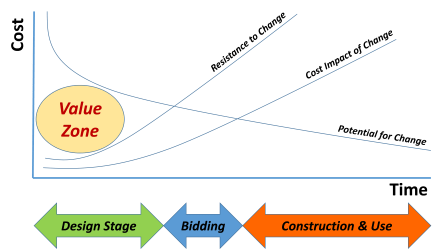
Whilst value engineering can be carried out at any point in the project life cycle, the earlier in the design process it is performed the better the results tend to be. As the project evolves, the design team become reluctant to embrace changes, which might involve them in additional non-recoverable expense. Equally, the cost impact of the changes proposed at these later stages will involve other factors beyond the simple capital cost (often; abortive work and consequential impacts).
This means that there is a zone at the beginning of a project where value engineering can make the largest impact with the least consequences, this is known as the “value zone” and is illustrated below.
Setting Expectations
A common question from many clients before undertaking any value engineering exercise is “how much should be the target for the savings we can achieve?” There is obviously no specific answer to this question since it depends upon the project and status of the design, but the expectations established at the start have to be realistic.
The financial issues on a project cannot be solved by a single value engineering exercise, nor can significant savings be achieved without major design changes. Therefore, it is important to consider what can actually be achieved. To establish a reasonable target a detailed review of the project design and latest cost estimate has to be carried out. This review should consider the following key issues:
- Scope / potential for brief / functional area reductions
- Practicality to implement alternative building services systems / technology
- Ability to consider alternative structural systems
- Areas of uncertainty in the estimate pricing
- Aspects of the design which are less developed
Designers, suppliers, and contractors can all assist in this review by providing the evaluation team with expert knowledge and technical information. Building Service systems are a key aspect where manufacturers and suppliers can provide significant support. The best of these businesses are able to offer alternative solutions to standard problems, (many of which involve higher capital investment but substantial long-term benefits) based upon the selection of different items from their existing product range. This ability to think and work outside the “easy” or “regular” solution is what distinguishes the good from the best suppliers. Successful value engineering studies always require the active involvement of these firms and design teams should actively seek out these experts wherever possible.
Despite the vast number of variables in the design of any project, it is typical that savings of between 15 – 20% of capital costs, are possible during the early stages of the design process, with between 10 – 12% being the most commonly achieved cost reduction range. As noted at the outset, these savings have to be tempered with the potential loss of revenue / other benefits any cost reductions might consequentially generate. As a rule, the higher the achieved capital cost savings, the greater the overall compromise in other areas, which will result.
Final Thought
Value Engineering is not a silver bullet; it is simply an additional tool within the toolbox of the construction industry professional. If used at the appropriate time the process can generate savings and reduce budget over-runs, but it will often be at the expense of either functionality or aesthetics.
If you want to read more about a structured process (called the “funnel” approach) designed specifically to reduce project costs without destroying value, please look at our Practical Guide to Performing Effective Value Engineering.

 Plateau Group